Weak random number generation left thousands of crypto wallets vulnerable to private key theft. Here’s how the Ill Bloom vulnerability works, who is affected, and why hardware wallets remained protected.
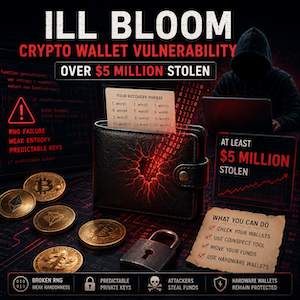
Check your Bitcoin balance. Still there? Great. But thousands of wallets weren’t so lucky.
In July 2026, security firm Coinspect dropped a bombshell: “Ill Bloom,” a critical vulnerability in crypto wallet software that has already drained over $5 million. Attackers are actively exploiting it right now.
The Flaw Inside Your Wallet
Here’s the thing. When you create a wallet, it spits out a recovery phrase—those 12 or 24 magic words that guard your Bitcoin. The strength of that phrase depends entirely on randomness. Good randomness means a practically uncrackable private key.
But some wallet software? It uses a broken random number generator (RNG). Weak entropy. Predictable patterns. Attackers can reverse-engineer the math and guess your private keys before you finish your morning coffee.
As one Coinspect researcher told The Hacker News in their July 10 report: “If funds recently moved without your permission, this vulnerability may be why.”
The Numbers Are Staggering
One source tracked 2,114 exposed addresses across six different blockchains—Bitcoin, Ethereum, Tron, Rootstock, and Polygon. Another investigation confirmed at least $3.1 million stolen in a single coordinated sweep on May 27, 2026. The final tally? Over $5 million gone.
Worst part? This weakness traces back to 2018. Some wallets were born vulnerable years ago. And Coinspect warns that more remain at risk if users haven’t rotated keys or migrated funds.
Why Hardware Wallets Never Felt a Thing
Now here’s where it gets interesting. Every hardware wallet reviewed on hardwarewallet.org sailed through Ill Bloom untouched. Not a single satoshi lost.
Why? Hardware wallets with secure elements use dedicated RNG hardware. Your private keys never touch your computer’s compromised software. They never meet that broken entropy source.
Trezor Safe 3, Safe 5, and Safe 7 run EAL6+ secure element chips with hardware-based random number generation, isolating key generation from any software RNG flaws.
Coldcard’s MK4, MK5, and Q deploy dual EAL6+ secure elements with hardware-based entropy, making them functionally immune to software RNG vulnerabilities.
Blockstream Jade and Jade Plus rely on hardware ADC noise for entropy combined with a blind oracle security protocol—not some software RNG implementation.
Ngrave Zero uses EAL7-certified secure hardware with dedicated hardware RNG, completely separate from host software entropy sources.
Keystone Essential, Pro, and 3 Pro use EAL5+ or triple secure chips from independent vendors with hardware-based random number generation.
The common thread? Key generation happens inside dedicated secure hardware, not in wallet software on your internet-connected phone or laptop.
What This Means for You
If you’ve been holding Bitcoin in a hardware wallet, breathe easy. Your secure element did its job. If you’re using software-only wallets—especially lesser-known mobile apps—this is your wake-up call.
The exploit is simple math for attackers: weak randomness equals guessable private keys. Your signatures become predictable. Your funds become theirs.
Coinspect has released a wallet-checking tool to see if your addresses are exposed. Use it. If you’re vulnerable, move your funds.
Because when attackers can predict your keys, hardware beats software every single time.