French Tax Authority Confirms Data Breach Affecting Hundreds of Thousands of Bitcoiners and Wealthy Taxpayers
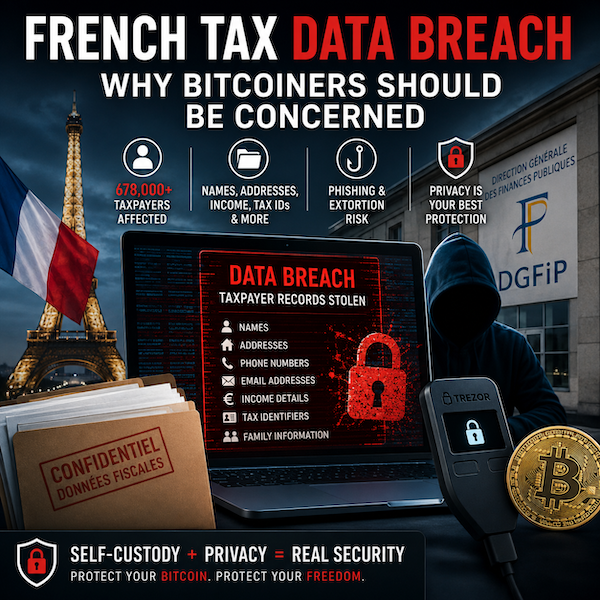
In June 2026, France’s tax authority DGFiP confirmed a data breach that should worry anyone holding digital assets. Stolen VPN credentials were used to extract taxpayer records, and a hacker is now selling a database containing data on 678,437 individuals and businesses. It is not just a government problem. It is a personal security problem.
The records include names, addresses, phone numbers, email addresses, income figures, tax identifiers, and family details. Among the exposed records are 26,805 high-income individuals earning above roughly $116,000 per year, 386 above $1.16 million, and 8 above $11.6 million.
That information gives criminals material for highly personalized and credible phishing or extortion attempts, because they know the victim’s actual tax details. A message that references real income or family data can look official, making targets more likely to respond. The risk is especially sharp in France.
A thief does not need to break into your wallet if they can trick you into moving funds. Tax records make the story more convincing, especially when paired with identity details collected elsewhere.
A Dangerous Country for Crypto Holders
France is already the leading country for wrench attacks, a form of physical robbery where criminals use violence or threats to force cryptocurrency holders to transfer funds. There were 30 such attacks in France in the first half of 2026 alone, with over $30 million stolen according to Chainalysis.
When a government tax authority stores detailed financial and personal data on citizens, that centralized data becomes a high-value target. Breaches expose not just numbers, but the exact income and location of people known to hold wealth.
For Bitcoiners, this breach is a reminder that self-custody is only one layer of security. Privacy is the other. The less information any third party holds about your holdings, your address, and your income, the smaller your attack surface.
Using a hardware wallet is the first step to taking coins off exchanges. But users should also avoid linking personal identity to public addresses when possible, and consider address rotation and coinjoin tools for additional privacy.
KYC is Dangerous
KYC data held by exchanges is a similar target. When you buy Bitcoin through an exchange that requires identity verification, that exchange holds your name, address, and purchase history, a profile just as attractive to thieves as the DGFiP database.
Attackers can combine leaked tax files with exchange leaks, public blockchain analysis, and social media posts. That creates a map from your legal name to your likely wealth, and sometimes to your coins.
Strong privacy habits do not eliminate risk, but they reduce the clues that help criminals find, target, and pressure you.
Take control of your Bitcoin security with a hardware wallet and keep your holdings private with one of the devices on hardwarewallet.org.