Here’s a sobering truth that keeps Bitcoin owners awake at night.
One wrong click. One house fire. One lost device. That’s all it takes to watch your life savings vanish into the digital void.
But what if you could make your Bitcoin virtually untouchable? What if hackers, thieves, natural disasters, and even your own forgetfulness couldn’t touch your wealth?
There’s a way. And it’s simpler than you think.
The Cold, Hard Reality of Single-Point Failures
Picture this for a second.
You’re holding your entire net worth in a single hardware wallet. That little device feels secure in your hand. It has a PIN. It never connects to the internet. You’re safe, right?
Wrong.
A single hardware wallet is still a single point of failure. One lost seed phrase. One natural disaster. One determined thief with a $5 wrench. Your Bitcoin is gone forever.
Here’s the thing nobody tells you: Bitcoin security doesn’t depend on Bitcoin itself. The protocol has never been hacked. The weak link is you. It’s how you protect your private keys.
And there’s only one method that eliminates every single point of failure while keeping you in complete control.
The Multisignature Fortress That Changes Everything
Multisignature—or multisig—is the most secure way to store Bitcoin. Full stop.
Instead of one private key controlling your funds, multisig allows Bitcoin to be controlled by multiple private keys. You can configure it so that not all keys are required to move your coins. Need two out of three keys to sign a transaction? Done. Want three out of five? That works too.
What does this mean in plain English?
Losing one key does not result in losing your funds. If one key is lost, stolen, or destroyed, you can rotate your coins to a new address using your remaining keys. Your wealth survives even when individual pieces don’t.
Compare this to traditional single-key storage. One mistake equals total loss. That’s binary. That’s terrifying.
Multisig changes the math entirely.
How Hardware Wallets Transform Multisig From Expert-Only to Accessible
Here’s where it gets interesting.
Multisig used to be complex. It used to be limited to experts, developers, and serious institutions. The technical barriers were high enough to exclude ordinary Bitcoin holders.
Those days are over.
Hardware wallets make multisig setup simple and foolproof. These devices generate and sign transactions completely offline. The keys created on hardware wallets never go online and cannot be hacked via the internet. Hardware wallets eliminate most risks related to exchange hacks and online wallet compromises.
Modern hardware wallets integrate seamlessly with multisig wallets. They simplify handling keys and reduce setup mistakes that used to plague complex configurations.
You don’t need to be a programmer anymore. You don’t need to understand cryptographic mathematics. You just need the right devices and the right process.
The Multi-Vendor Strategy That Eliminates Supply Chain Risk
Now let’s talk about something most people ignore until it’s too late: supply chain attacks.
State-level attacks on Bitcoin infrastructure are becoming more likely. Manufacturers can be compromised. Devices can be tampered with during shipping. Firmware can contain hidden vulnerabilities.
When you use identical hardware wallets from the same vendor in your multisig setup, you’re trusting that one company completely. A single supply chain attack—one preinstalled vulnerability, one piece of malware, one bug that slipped through quality control—could cost you everything.
Here’s the solution that security professionals use: multi-vendor multisig.
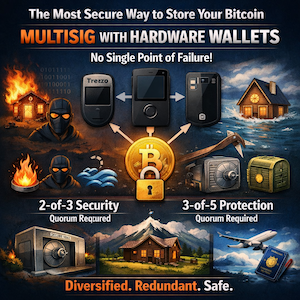
Diversifying hardware wallet vendors improves your security dramatically. Using different devices from different manufacturers reduces the risk of shared vulnerabilities. If you use a 2-of-3 setup with devices from three different vendors, one vendor failure doesn’t compromise your funds. Your remaining keys from other vendors stay safe.
Mix different brands. Choose devices based on your privacy, cost, and security preferences. Geographic diversity matters too—different jurisdictions, different supply chains, different points of failure.
Interestingly, using multiple cheaper devices from different vendors can actually be more secure than using identical premium devices from a single source.
This approach eliminates device-level single points of failure.
Setting Up Your Unbreachable Security System
Let’s walk through what this actually looks like in practice.
First, select a compatible multisig wallet and choose hardware devices that work with it. Common recommended setups are 2-of-3 and 3-of-5 configurations. A 2-of-3 setup requires two of three devices to sign transactions, meaning one key can be lost without losing access to your funds.
Order your devices directly from manufacturers, not resellers. Supply chain attacks are a realistic risk in Bitcoin security, and factory-direct hardware wallets reduce this threat significantly. Verify firmware signatures when updating devices. Some hardware wallets even allow multisig registration directly on the device itself, providing additional backup and verification layers.
Once you have your hardware wallets, you must register them in your multisig wallet. Each hardware wallet must be backed up with a 12-24 word seed phrase. These backup seeds represent full ownership of your Bitcoin. Store these seeds on paper or metal backups in separate locations—use tamper-proof envelopes to detect if seeds have been compromised.
Distribute keys across multiple safe locations. Keys must be stored in different locations to truly eliminate single points of failure. Physical attack resistance becomes important depending on where you’re storing devices. Consider air-gapped multisig setups for improved security against hackers.
Backing up the wallet configuration file is critical—while this file is privacy-sensitive, it doesn’t give direct access to funds, but losing it complicates recovery significantly. Higher thresholds increase theft protection but also increase loss risk, so choose carefully based on your threat model.
Before you commit serious funds, test your multisig with a small transaction. Make sure you understand the process. Verify everything works. Confidence comes from practice.
Finally, fund your multisig only after distributing keys to their secure locations. Signing devices aren’t even required when depositing Bitcoin, so distributing keys before funding reduces risks during travel or transport.
Protection Against Every Imaginable Threat
Let’s be specific about what this multisig fortress protects you against.
Hackers? Even if they compromise one device, they can’t move your funds without additional keys. Your other devices remain secure.
Theft? A thief stealing one hardware wallet gains nothing. They need multiple keys from different locations.
Fire or flood? Distribute your seeds and devices geographically. One location destroyed doesn’t mean lost funds.
Loss? Misplace a device? Your remaining keys maintain access. Create a new multisig setup with your secure keys. Only compromised devices need replacement—not everything.
Physical coercion? Advanced setups support time locks and decaying keys. Some configurations allow automated ownership transfers without trusted third parties, replacing traditional financial services with transparent and incorruptible code.
Self-custody is essential to avoid exchange hacks, defaults, or confiscation. Exchanges should only be used for buying and selling—then funds should be withdrawn immediately to your control. No bank, broker, or vault can offer the same level of control and security as self-custodied Bitcoin in multisig.
Beyond Security: The Flexibility Benefits
Multisig isn’t just about defense. It enables powerful capabilities that single-key storage can’t match.
Multisig enables inheritance planning for Bitcoin holders. Your heirs can access funds according to predefined rules without you having to trust them with full control today.
Multisig supports collaborative custody with professionals without losing ownership. You can get expert assistance managing your keys while maintaining ultimate control. Multiple people can manage funds together according to agreed rules.
Hybrid multisig setups combine automation and human oversight. Spending limits can restrict how much moves without additional authorization. Advanced setups allow for sophisticated governance that would require expensive legal structures in traditional finance.
Bitcoin in multisig with multiple hardware wallets is one of the most secure ways to store wealth long term. Bitcoin has no counterparty risk, no debasement, no permission requirements, and is borderless. Bitcoin is property in cyberspace and can be accessed globally using private keys.
Private keys can exist physically, digitally, encrypted, or memorized. Remember: if you own the keys, you own the Bitcoin.
Best Hardware Wallets for Multisignature
Coldcard
Coldcard is built specifically for serious multisig users and is widely used in professional multi-vendor setups. It supports up to 15 signers and enables fully air-gapped signing using microSD cards, NFC, and QR workflows. Coldcard integrates seamlessly with multisig coordinators like Sparrow, Specter, Electrum, Nunchuk, and other PSBT-compatible wallets, making it extremely flexible for advanced configurations. Its Bitcoin-only design and offline-first approach make it one of the most trusted devices for secure multisig storage.
Trezor
Trezor helped bring multisig to mainstream users by combining simplicity with broad compatibility. While Trezor Suite itself does not natively manage multisig, Trezor devices work smoothly with wallets like Sparrow, Specter, Electrum, and Casa, making multisig accessible without deep technical knowledge. Its open-source firmware, intuitive interface, and long track record make Trezor a popular and reliable signer in multi-vendor multisig setups.
Blockstream Jade
Blockstream Jade focuses on open-source security and air-gapped flexibility. It supports QR-based signing, stateless signing modes, and multisig configuration registration directly on the device. Jade integrates with multisig wallets such as Sparrow, Specter, Blockstream Green, and other QR-compatible coordinators, making both beginner and advanced setups possible. Its fully air-gapped camera-based workflow ensures keys remain offline while still keeping multisig setup simple and secure.
Cobo Vault
Keystone, former Cobo Vault with air-gapped devices, pioneered user-friendly multisig through QR-code signing and offline key management. These devices integrate well with Sparrow, Specter, Electrum, and other multisig wallets, making them ideal for multi-vendor setups. With air-gapped architecture, secure elements, and strong physical tamper resistance, Cobo-style devices remain popular choices for long-term multisig cold storage strategies.
Your Move
You now understand what separates vulnerable Bitcoin holders from those sleeping soundly at night. You know why single hardware wallets—even good ones—represent unacceptable risk for serious wealth. You’ve seen how multi-vendor multisig with factory-direct hardware wallets creates security that rivals—no, exceeds—any bank vault on earth.
The tools exist. The knowledge is accessible. The only question remaining is whether you’ll act on what you know.
Because here’s the final truth: Bitcoin security depends entirely on how users protect their keys rather than Bitcoin itself. Hardware wallets and multisig make high-level Bitcoin security accessible to individuals. But you have to use them.
Your future self—safe, secure, and in complete control of unseizable wealth—will thank you for taking action today.