What happens when the money in your digital wallet isn’t really yours?
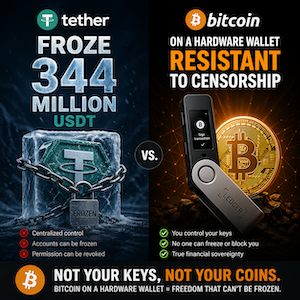
In April 2026, Tether froze more than $344 million across two cryptocurrency wallets. The funds vanished from circulation within minutes. Not hours. Not days. Minutes.
Here’s the kicker: these weren’t traditional bank accounts frozen by court order. These were digital assets held on the Tron network, supposedly decentralized, supposedly yours. But stablecoin issuers like Tether have a technical backdoor—a blacklist function that renders tokens unusable instantly. Two wallets. $344 million. Gone.
And they’re not acting alone.
The Growing Alliance Between Stablecoins and Surveillance
Tether doesn’t freeze funds on a whim. These actions are coordinated with heavy hitters: the Office of Foreign Assets Control (OFAC), international law enforcement, and regulatory bodies across the globe. Tether actively cooperates with hundreds of agencies worldwide and has frozen billions of dollars in total since it started these operations.
You might be thinking: “Good. Stop the criminals.”
But here’s where it gets uncomfortable.
Freezing typically begins with large, high-profile targets—criminal networks, sanctioned entities, the “bad guys” nobody defends. Yet history tells us something worrying. There’s a strong regulatory and political incentive for authorities to expand financial surveillance over time. When geopolitical tensions rise, when sanctions multiply, when conflicts escalate—financial controls don’t shrink. They grow.
The tools used to freeze cartel money today become the tools used against political dissidents tomorrow. Then smaller businesses. Then ordinary individuals who said the wrong thing, bought the wrong product, or associated with the wrong person.
This isn’t speculation. It’s pattern recognition.
Counterparty Risk: The Trust You’re Forced to Give
Every stablecoin in your portfolio carries an invisible string attached—a centralized issuer who can pull it anytime.
You must trust that Tether won’t freeze your funds arbitrarily. You must trust they won’t bend to shifting political winds. You must trust they won’t decide tomorrow that your transaction history, your geography, or your associations make you a “risk.”
That’s not ownership. That’s custodianship with extra steps.
Stablecoins rely on centralized issuers, which introduces counterparty risk for anyone holding them. Your “digital dollars” are IOUs, and the issuer can stop honoring them instantly. No judge. No jury. Just code executing a command.
Bitcoin: Money That Can’t Be Switched Off
Now compare this to Bitcoin.
Bitcoin operates without a central authority. It has no CEO. No support hotline. And crucially—no built-in mechanism to freeze funds.
No government, company, or organization can unilaterally block or reverse a valid Bitcoin transaction at the protocol level. There is no blacklist function in the Bitcoin protocol. The network is maintained by a decentralized global network of nodes and miners enforcing consensus rules—not taking orders from Washington, Brussels, or anywhere else.
Ownership isn’t determined by an account at some company. It’s determined solely by control of private keys. Anyone with access to the private keys can move funds without needing permission from a third party. You don’t call anyone. You don’t fill out a form. You sign a transaction and the network validates it objectively.
Bitcoin transactions are permissionless and censorship-resistant by design. All transactions are visible on the public ledger—total transparency—but no central party can selectively block them. Bitcoin’s design separates transparency from control. Everyone can see the money move. Nobody can stop it from moving if you hold the keys.
The Power of Self-Custody
This brings us to the practical difference between hoping for the best and guaranteeing your financial sovereignty.
Self-custody allows you to hold your own private keys instead of relying on exchanges or custodians. When you hold Bitcoin in self-custody, you remove the risk of account freezes, withdrawal limits, or third-party insolvency. The exchange can’t lock you out. The government can’t call a company to seize your balance. Even state-level actors cannot directly control Bitcoin balances without obtaining your private keys.
Bitcoin cannot be seized or frozen remotely without access to those keys.
Hardware wallets make this practical by storing private keys offline, reducing exposure to hacks, malware, and phishing attacks. Your sensitive information never touches an internet-connected system. It’s just you, a small device, and a seed phrase that unlocks wealth nobody else can touch.
Using Bitcoin with proper self-custody provides a form of financial sovereignty independent of traditional systems.
The Trade-Off That Matters
There’s a catch—because nothing is free.
The trade-off of self-custody is full personal responsibility for securing backups and private keys. Lose your keys? Lose your funds. Permanently. No “forgot password” button. No customer service to beg. Just cold, irreversible mathematics.
Some find that terrifying. Others find it liberating.
But before you decide which camp you’re in, consider this: the contrast between Bitcoin and stablecoins highlights a fundamental difference between decentralized and centrally controlled digital money. One can be switched off in minutes by a coordinating authority. The other requires physical access to your secrets to control.
Choose Your Financial Reality
$344 million disappeared in minutes. Not because of a hack. Not because of a market crash. Because an issuer decided those wallets were “flagged for illicit activity,” and the code obeyed.
Your stablecoins aren’t truly yours. They’re conditional. Borrowed against a promise from a corporate entity that must please hundreds of agencies worldwide.
Bitcoin is different. It doesn’t know your name. It doesn’t check your passport. It doesn’t care if you’re a billionaire or a dissident. If you have the keys, you have the money. No executor. No judge. No freeze.
The question isn’t whether Tether and other stablecoins are useful. They are. The question is: do you want money you can use, or money that can be taken away?
Start small. Learn to hold your own keys. Because the next $344 million freeze is already being coordinated—and you don’t want to be the one learning about these risks the hard way.