Bark just Launched on Bitcoin | Self-Custodial Bitcoin Without Lightning’s Headaches
What if holding your own Bitcoin was actually easy?
Picture this. You want to buy coffee with Bitcoin, but you’re staring at screens full of channel balances, liquidity ratios, and routing fees. So you give up. You use a custodial LN wallet instead.
You’ve been there, haven’t you?
That’s precisely the pain point that’s pushed mainstream users toward custodial wallets for years. But on June 9, 2026, something changed. Second, a Bitcoin development lab, officially launched Bark on Bitcoin mainnet. This isn’t just another layer-2 experiment. It’s a direct challenge to the complexity that’s been holding Bitcoin adoption back.
How Bark Makes Self-Custody “Ridiculously Easy”
Bark is built on the Ark protocol, a layer-2 solution that takes a completely different approach from Lightning. Rather than locking funds into payment channels, Ark allows large groups of users to share on-chain UTXOs through trees of pre-signed, off-chain transactions.
Here’s what this means for you. When you use Bark, you’re spreading fee costs across all participants while keeping individual control of your funds. No shared custody. No surprises. Just Bitcoin that actually works like money.
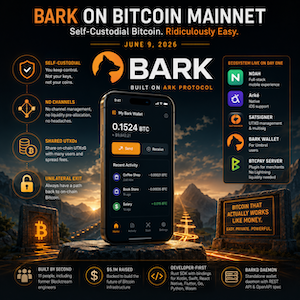
“We want to make self-custodial Bitcoin ridiculously easy to hold and spend,” says Steven Roose, CEO of Second. No channel management. No liquidity pre-allocation. No surprise fees eating your balance when you least expect it.
The Technical Magic: Virtual UTXOs
Under the hood, Bark uses something called Virtual UTXOs, or vUTXOs. These are pre-signed transactions locked with a 2-of-2 multisig between you and an Ark Service Provider. The magic? You can unilaterally exit to on-chain funds at any time.
Think of it as having a direct escape hatch back to base layer Bitcoin that nobody can block. Your provider helps coordinate off-chain, but they can never take your coins. It’s a subtle but crucial distinction that preserves the “not your keys, not your coins” ethos without the operational headache.
A Full Ecosystem Ready on Day One
Second didn’t just ship code. They shipped an entire developer toolkit. The Bark SDK is written in Rust, but comes with bindings for Kotlin, Swift, React Native, Flutter, Go, Python, and WebAssembly. If you’re building on Bitcoin, Bark speaks your language.
For server environments, there’s Barkd, a standalone wallet daemon with a REST interface and full OpenAPI spec. This means merchants, exchanges, and power users can integrate Ark functionality without rebuilding their entire stack.
At launch, five applications are already mainnet-ready. Noah offers a full-stack mobile experience. Arke brings native iOS support. Satsigner handles UTXO management and multisig. There’s a Bark Wallet app for Umbrel users, and crucially, a BTCPay Server plugin for merchants who want to accept payments without Lightning’s liquidity constraints.
The Origins and Trade-offs
The Ark protocol itself came from Burak, a Turkish developer who saw the gaps in existing scaling solutions. Today, two competing implementations exist: Ark Labs’ Arkade and Second’s Bark.
Second brings serious credentials to the table. They’ve raised $5.1 million and employ 11 people, including former Blockstream engineers who know Bitcoin’s codebase at the deepest levels.
But here’s where it gets interesting. Ark presents almost opposite trade-offs to Lightning. It’s more blockspace-efficient for off-chain transactions and eliminates those liquidity allocation headaches entirely. The catch? Throughput is more closely tied to on-chain blockspace limits.
It’s a different set of compromises, not a magic bullet. For users who’ve struggled with inbound liquidity or channel management, those trade-offs might feel like breathing fresh air.
What About Hardware Wallet Support?
One question that remains unanswered is whether Ark can eventually live inside hardware wallets.
The short answer? Probably yes.
Unlike Lightning, Ark does not require users to manage payment channels, monitor liquidity, or maintain complex routing relationships. At its core, Ark still relies on standard Bitcoin signatures and multisig constructions, which means existing hardware wallets are already capable of signing the types of transactions Ark uses.
That makes Ark significantly easier to integrate with hardware wallets than Lightning ever was.
But that doesn’t mean it’s simple.
The Challenge for Hardware Wallets Isn’t Signing. It’s Understanding.
The real obstacle isn’t whether a hardware wallet can sign Ark transactions. It’s whether it can clearly explain what you’re signing.
Ark relies on structures such as virtual UTXOs, pre-signed transaction trees, refresh rounds, and unilateral exit paths. While these mechanisms are designed to make Bitcoin easier to use, they also introduce complexity behind the scenes.
A hardware wallet’s job is not just to protect your keys. It’s to help you verify exactly what is happening to your money. Translating Ark’s underlying mechanics into something an average user can understand on a small device screen remains an open challenge.
That said, the future looks promising.
If Ark adoption continues to grow, hardware wallet manufacturers will have a strong incentive to build dedicated support directly into their firmware. Among today’s devices, the COLDCARD appears to be the strongest candidate. Its focus on Bitcoin-only security, air-gapped signing, PSBT workflows, and advanced transaction verification aligns surprisingly well with Ark’s architecture.
Whether Ark becomes a standard feature in hardware wallets remains to be seen. But unlike many Bitcoin scaling experiments, there’s nothing about Ark that fundamentally conflicts with self-custody hardware. If anything, it may prove to be one of the most hardware-wallet-friendly scaling solutions Bitcoin has produced so far.
Proceed with Eyes Open
Bark is new technology. Emerging protocols carry typical new-technology risks and should be approached with caution. Don’t put your life savings into experimental software. Test with amounts you can afford to lose.
But also, don’t let perfect be the enemy of good. For years, Bitcoin has faced a false choice between ease-of-use and self-custody. Lightning is brilliant technology, but the channel management and liquidity requirements have pushed ordinary users toward custodial solutions they don’t actually want.
Bark offers a third path. One where you can spend and hold Bitcoin without becoming a network engineer. Where your coffee purchase doesn’t require you to understand HTLCs or balance your channels at 2 AM.
The launch on June 9, 2026 marks not just a technical milestone, but a philosophical one. Self-custody shouldn’t require a computer science degree. It should be ridiculously easy. Thanks to Second and Bark, for millions of Bitcoin users, it finally might be.