COLDCARD Mk5 Review 3 Months After Launch
Is the Upgrade Worth Your Bitcoin?
Three months. That’s how long I’ve been carrying the COLDCARD Mk5, tossing it into bags, plugging and unplugging it for transactions, and using it as part of my regular Bitcoin routine.
Here’s the thing about hardware wallets. Most people buy one, set it up once, and then lock it away in a drawer or safe. But hardware wallets aren’t just meant to be stored. They’re meant to be used. To verify addresses. To sign transactions. To protect your private keys without sacrificing control.
After 90 days of real-world use, I have a pretty good sense of what Coinkite got right when they released the COLDCARD Mk5 on March 10, 2026. And while this isn’t a revolutionary redesign, it is a thoughtful refinement of one of Bitcoin’s most respected hardware wallets.
What Actually Changed (And What Didn’t)
Let’s address the elephant in the room first. This is not a redesign. Coinkite positioned the Mk5 as a backward-compatible upgrade, and they meant it. Your 24-word BIP39 seed phrase from your Mk4? It slides in without a hiccup. Your workflows? Identical. The threat model? Exactly the same.
But pick one up, and the physical refinements hit you immediately.
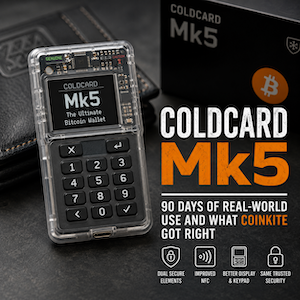
That new 1.54-inch display protected by Gorilla Glass makes a difference you can see and feel. I don’t use screen protectors. I throw this thing in my bag with keys, coins, and whatever else accumulates in there. After three months, not a scratch. The clarity is noticeably sharper than the Mk4’s older screen, especially when you’re squinting at transaction details in bright sunlight.
Then there’s the keypad. Coinkite redesigned the numeric layout with tactile keys that actually click. If you’ve ever fat-fingered a PIN entry on a hardware wallet, you know the cold sweat that follows. These raised, responsive buttons make input errors during transaction signing far less likely. You feel the engagement. You know the digit registered.
The USB-C port moved, too. It’s now on the bottom of the device instead of the side. Seems trivial until you set the unit on your desk to sign a transaction. The cable doesn’t torque the device anymore. It sits flat. It stays put. Small ergonomic win, but one you’ll appreciate during heavy-use periods.
Oh, and colors. For the first time in COLDCARD history, you can get something other than that standard clear-case appearance. Personal preference, sure. But when you’re carrying a device that holds your life savings, having it look like something you actually chose matters more than you’d think.
The Security Architecture That Refuses to Change
Here’s where Coinkite deserves credit. They resisted the temptation to fix what wasn’t broken.
The Mk5 retains the same dual secure element setup as previous models. Two chips from different vendors—Microchip and Maxim—work together to protect your seed. This isn’t redundancy for show. It’s a security model built on the idea that compromising two different hardware architectures simultaneously is exponentially harder than cracking one. Your keys never exist in a single point of failure.
The core cryptographic operations and signing algorithms remain unchanged from the Mk4. Coinkite didn’t tweak the math. They didn’t introduce new attack surfaces. When you’re storing generational wealth, consistency in the security model beats novelty every single time.
Flip the device over. See that circuit board through the clear casing? The exposed green and red genuine-vs-caution circuit is still there. Physical tamper-evidence isn’t marketing copy. It’s a visible guarantee that someone hasn’t opened your device, replaced components, or compromised the hardware before it reached your hands. Green means genuine. Red means caution. No app required. No bluetooth pairing. Just eyes.
The anti-phishing words still appear during PIN entry, unique to your device’s specific PIN prefix. You’ve probably forgotten this feature exists because it works so quietly. But those two words anchoring your memory every time you unlock? They’re your mental checksum against fake devices and social engineering.
And those trick PIN features you maybe set up on day one and never thought about again? They’re all here. The duress PIN that opens a decoy wallet. The brick-me PIN for absolute destruction of keys under coercion. Login countdown timers for forced delays. Full BIP39 passphrase support. No functional changes, no surprises. Your contingency plans still work exactly as you configured them.
NFC That Finally Feels Ready
The NFC upgrade is the silent hero of this release.
Previous COLDCARDs had NFC. But the Mk5’s implementation is faster and more reliable for tap-to-sign operations. Three months in, I’ve stopped thinking about whether the connection will hold. I tap. It signs. I broadcast.
Push TX transactions—where you move signed bitcoin from your air-gapped device to the network without ever plugging in a cable—finally feel seamless. You tap the COLDCARD against your phone. The transaction broadcasts. Your keys never touched the internet. Your device never connected to a potentially compromised computer.
This matters. You bought a hardware wallet specifically for this guarantee. The Mk5 delivers it more smoothly than any previous model.
Migration, Verification, and the Air-Gapped Promise
Because the Mk5 is 100 percent backward compatible, existing users face zero friction. Migrate your seed. Keep your workflows. The firmware remains open-source, buildable and verifiable independently using reproducible build tools. You don’t trust Coinkite. You verify.
It remains Bitcoin-only. No altcoin bloat. No blockchain tourism. Just pure, focused security for the hardest money ever created.
One caveat: the smaller physical size might affect your third-party cases or mounting solutions. If you had a 3D-printed holster or a custom metal case for your Mk4, test the fit before you commit. The device changed shape just enough to matter.
The Value Proposition Against the Q
Coinkite sells the COLDCARD Q at a premium price. Full keyboard. QR scanner. Beefier hardware.
The Mk5 is marketed as the entry-level option. It costs less. It does less. But here’s the critical distinction: it secures your bitcoin nearly identically. The dual secure elements from Microchip and Maxim work the same. The seed protection is identical. The air-gapped signing is identical.
You’re not buying lesser security. You’re buying a streamlined experience. If you don’t need the full keyboard and QR scanner of the Q model, the Mk5 gives you Coinkite-grade protection without the premium overhead.
Three months of daily carry and transaction signing have convinced me of something important. The Mk5 isn’t an entry-level device. It’s a refined tool. It strips away what you don’t need and perfects what you do.
Your bitcoin deserves hardware that gets out of the way while keeping your keys offline. After 90 days of abuse, the Mk5 has proven it can do exactly that. Take your Mk4 seed. Load it in. Verify the firmware yourself. Then get back to stacking sats with confidence that your security architecture hasn’t changed, even if everything else feels better than it ever has.
Do you want to try the Coldcard MK5 for yourself? GET IT HERE.