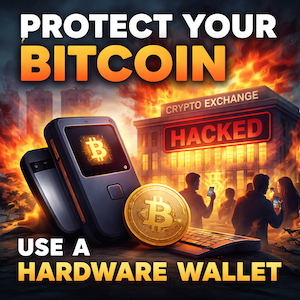
Imagine opening your phone one morning and seeing the headline: withdrawals paused. Your balance still appears on the screen, but every attempt to move your Bitcoin fails. Hours later, rumors spread across social media. The exchange you trusted has been hacked. Billions gone. Support tickets unanswered. Within days, the website goes dark, and your savings vanish with it.
This is not a rare black swan. It has happened repeatedly — from Mt. Gox to FTX to countless smaller platforms that quietly disappeared. Each time, users believed their Bitcoin was safe until the moment it wasn’t. When you leave your coins on an exchange, you are not holding Bitcoin at all. You are holding a promise, and promises can break.
A hardware wallet is a must have, you’ll never worry about a situation like this!
What This Device Actually Does
So what exactly is a hardware wallet? Despite the name, it is not a leather billfold stuffed with digital cash. It is a physical device, small enough to fit in your palm, that generates and stores your private keys in an offline environment. Think of it as a vault that never touches the internet, which means hackers cannot reach it through WiFi, phishing links, or exchange breaches.
When you need to spend, the device signs your transaction internally, authorizing the movement of funds without ever exposing your sensitive information to a connected computer. You become the bank, with no customer service to call and no password reset emails, just absolute control.
Why 20% of Bitcoin Is Gone Forever
Leaving your Bitcoin on an exchange is not saving; it is gambling with your financial sovereignty. You are trusting a company to keep your keys safe while they face constant attacks from sophisticated thieves and regulatory overreach. By moving your assets to a hardware wallet, you remove that counterparty risk entirely and become self-sovereign.
But true security extends beyond building walls against hackers; it requires ensuring the people you love can enjoy what you have built without the worry to lose everything. The right answer is a self-custody setup that puts you in control today while protecting your family’s financial future tomorrow.
Finding Your Perfect Match
Choosing your first hardware wallet feels overwhelming because the marketing makes every device sound identical. But your technical background, your threat model, and your specific goals matter enormously. A total beginner needs intuitive design and clear instructions, while a privacy advocate demands open-source transparency. Long-term holders might prioritize rugged durability and inheritance features.
There is no single best hardware wallet for everyone, but there is absolutely a best one for your specific situation, and narrowing it down starts with honest self-assessment.
For Beginners: Trezor Safe 5
If you are just starting out and feeling overwhelmed by technical setup, the Trezor Safe 5 offers an intuitive experience without sacrificing security. It features a color touchscreen that makes navigation feel familiar, almost like using a smartphone, while keeping your private keys permanently air-gapped from internet threats.
The setup process guides you through backup procedures gently, so you do not need to be a cypherpunk to use it effectively. You get robust protection against remote attacks without the complexity that often scares away newcomers. It proves that security and usability can coexist.
For Advanced Users: Coldcard
Seasoned Bitcoiners who want granular control gravitate toward the Coldcard for its Bitcoin-only focus and advanced features. Unlike multicurrency devices that spread development thin, Coldcard assumes you are here solely for sound money. It includes options like dice-roll entropy generation for creating your own seed phrases manually, and a physical security model that assumes you are paranoid by default.
Every component is designed for maximum verification and minimum trust. If you enjoy opening the hood and inspecting the engine, this is your tool.
For Open-Source Purists: Blockstream Jade
Transparency matters when trust is the currency of last resort. Blockstream Jade offers fully open-source firmware, meaning anyone in the world can audit the exact code running on their device. No hidden backdoors, no proprietary secrets, and no wondering whether a corporation included surveillance features.
This aligns perfectly with Bitcoin’s ethos of “don’t trust, verify,” giving you cryptographic certainty that the device does exactly what it claims. For the privacy purist, open source is not a preference; it is a requirement.
For Zero-Trust Security: Ngrave
Perhaps you want to eliminate seed phrases entirely and achieve military-grade assurance. The Ngrave lineup offers EAL6+ certification, the highest security rating available in the consumer hardware wallet space, combined with a zero-trust architecture that removes traditional recovery seed vulnerabilities.
This makes offline payments possible in a truly trustless manner, eliminating the anxiety of writing down twelve or twenty-four words on paper that could be stolen or destroyed. It is designed for those who view their stack as generational wealth requiring maximum protection. When failure is not an option, this is the standard.
It Is Not Just About Blocking Hackers
But here is the part nobody talks about at dinner parties. Simply hiding a hardware wallet in a safe deposit box can become a major problem if your family cannot find it or does not understand how to use it after you are gone. True self-custody means creating a secure setup that is also accessible to your heirs, not just blocking hackers today.
The right device adds intentional friction to your own spending, which actually helps if your real issue is impulse selling, while ensuring your legacy survives you. It transforms solitary custody into a continuity plan. You are not just protecting bits; you are protecting your family’s financial future.
Your Move
You have worked too hard to stack these sats only to lose them to a forgotten password or a hacked exchange. Choose your device from the trusted manufacturers above, set it up this week, and sleep soundly knowing that your Bitcoin is finally where it belongs—in your hands alone.
Did you get interested? Compare the best hardware wallets available here and get your financial future into your own hands!