Why Aren’t You Using this Amazing Feature?
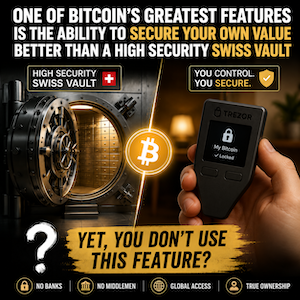
Imagine walking into a Swiss bank. Behind those polished marble walls sits a vault carved into a mountain. Armed guards patrol the perimeter. The vault door—solid steel and concrete—weighs three tons. To open it requires biometric scanners, time locks, and a committee of executives turning their keys in unison.
You’d feel pretty safe storing your life’s savings there, right?
Now imagine I told you that within five minutes, without spending a single dollar, you could secure your wealth better than that vault ever could. No guards. No walls. No steel doors. Just mathematics stronger than concrete.
Sounds impossible. But here’s the thing—thousands of people already do this every day. And most don’t even realize they’re neglecting the single greatest security innovation in human history.
The Thousand-Year Security Problem
Vikings sailed up rivers and plundered entire villages. Gold shipments disappeared during wars. Your grandfather told stories about family jewelry vanishing during the night. Throughout human history, security wasn’t just a preference—it was a necessity for survival.
Property rights form the bedrock of civilization. Without them, there’s no progress, no savings, no future. So humans built walls. They erected vaults. They strung barbed wire and hired armed guards. This approach worked, after a fashion.
But look closer at the economics.
Concrete walls cost money. Security personnel demand salaries. Surveillance systems require maintenance. The price of protection centralizes wealth into the hands of those powerful enough to bear these expenses. Kings. Banks. Governments. And where power concentrates, corruption inevitably follows.
Even that Swiss vault carries risks you can’t eliminate. A lost war brings plundering armies through those marble halls. A judge signs a warrant, and your assets legally change hands while you watch. Insider trading, embezzlement, fraud—the human element betrays you when you least expect it.
The fortress model has a fundamental flaw. The harder you make the vault, the more you telegraph to the world that something valuable sits inside. Convoys traveling with armored cars scream “rob me.” Yachts moored in Monaco harbor shout “I have assets worth taking.”
There’s a smarter way. Always has been.
The Pirate’s Secret (And Why It Failed)
Remember the treasure maps from pirate stories? An X scratched onto parchment. A shovel. Midnight.
People have buried gold in their backyards for centuries. Not because they lacked better options, but because hiding something eliminates the structural costs of defending it. No guards to pay when nobody knows the location. No walls to build when the location itself is the secret.
It’s genius in its simplicity. A teenager with a shovel achieves security rivaling that Swiss vault—assuming the hiding spot stays secret.
But here’s where the strategy breaks down in the modern world.
Where would you hide your entire life savings? Seriously. Think about it.
Under your mattress? A thief with a metal detector finds it in ten minutes.
Behind the drywall? Your contractor sees the fresh spackle.
In a safety deposit box at a bank? You’re back to trusting institutions—precisely what we wanted to avoid.
Physical hiding fails because geography is limited. There are only so many places in your house. Limited locations mean discoverable locations. And discoverable locations demand security apparatus to protect them. You’re back to square one.
Unless,
you could hide valuables in a space with unlimited room. A hiding spot requiring no real estate, no construction, no personnel. A place where you could stash unlimited wealth in five minutes, for free, with mathematical certainty that no human could ever stumble upon your treasure by accident.
Welcome to Bitcoin.
Your Indestructible Digital Vault
Here’s how it works. When you set up a Bitcoin wallet, you generate a private key. Think of this as the coordinates to your hiding spot in cyberspace. The cost? Zero. The time required? Five minutes. The capacity? Unlimited.
No concrete. No armed guards. No steel doors. Yet this digital “location” protects your money better than any physical structure ever built.
Why?
Because instead of hiding behind walls, you’re hiding behind an astronomical number. So vast that human minds struggle to comprehend its scale. So large that “guessing” your private key through brute force isn’t difficult—it’s as close to physically impossible as mathematics allows.
How big are we talking about?
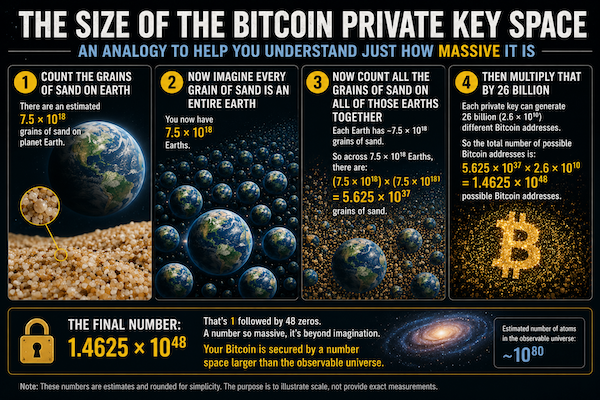
There are approximately 7.5 × 10¹⁸ grains of sand on Planet Earth. Now imagine every single one of those grains became an independent Earth itself. Each of these new Earths holds another 7.5 × 10¹⁸ grains of sand.
Multiply it out: across all those Earths combined, you’d have roughly 5.625 × 10³⁷ grains of sand.
Now the truly mind-bending part.
There are 26 billion times more possible private keys than grains of sand on all these Earths together!
The result? Approximately 1.4625 × 10⁴⁸ possible Bitcoin addresses.
Let that settle for a moment. It’s truly mind blowing how much Bitcoin addresses there are, and consequently how astronomical Bitcoin’s security is.
Visualize picking one specific grain of sand from that cosmic pile. Hiding your life savings behind it. Then tossing that grain back into the infinite beach.
Good luck to anyone trying to find it.
The Myth of Bitcoin Hacking
“But I’ve seen headlines,” you say. “People lose Bitcoin to hackers all the time.”
Right. And here’s where people confuse the security of the hiding spot with the vulnerability of the mapmaker.
Remember our grain of sand tower? Imagine you’re burying your treasure, and someone’s watching over your shoulder. They see exactly which grain you chose. Or, they steal your notebook where you wrote down the location. The hiding spot remains perfect. Your execution failed.
This distinction matters. When “Bitcoin gets hacked,” the protocol itself never breaks. Instead, hackers steal private keys from sloppy users. They install keyloggers on phones and computers connected to the internet. They trick people into revealing their backup phrases. They exploit human carelessness, not mathematical weakness.
The good news? These threats vanish with simple precautions.
Create your private key offline using a hardware wallet. A device never touched by the internet generates your hiding spot coordinates in complete isolation. Now no hacker—no matter how sophisticated—can observe your selection process.
Protect your backup seed (the written record of your key) physically. Store it somewhere secure, separate from the device. If a single copy worries you, advanced techniques eliminate even this risk.
Use a passphrase as additional encryption. Employ multi-signature setups requiring multiple keys to access funds. Or utilize Shamir’s Secret Sharing to split your key into pieces that must be combined to restore access.
Properly secured, your Bitcoin hiding spot becomes the most impregnable vault in existence. And it costs you nothing to maintain.
The Trillion-Dollar Mistake Most People Make
Now you understand the tool. So why does anyone buy Bitcoin ETFs? Why leave coins on exchanges?
It’s like this.
You walk into a gold dealer. You buy a gold bar. The dealer says, “Congratulations! Along with your purchase, you get complimentary access to the most secure Swiss vault on Earth. No fees. No rent. You hold the only key. The gold sits there forever, untouchable by governments, thieves, or bankers.”
Then you reply: “No thanks. Can you hold it for me in your desk drawer instead?”
That’s the level of strategic error happening when you buy Bitcoin without taking self-custody.
You’re purchasing a car, then remove the engine to let horses pull the chassis. You’ve acquired humankind’s greatest security innovation—and immediately surrendered it to the very centralized systems Bitcoin was designed to obsolete.
Exchanges freeze accounts during market volatility. ETFs are secured the old way by corrupted institutions. Third-party custodians face the same insider risks, war risks, and legal seizure risks that have plagued vaults for millennia.
The Swiss vault was free. You had the access. And you gave it back.
Claim Your Vault
Five minutes. That’s what stands between you and security that makes medieval fortresses look like cardboard boxes.
Human history shows us that possession determines survival. Those who controlled their property thrived. Those who entrusted it to others often lost everything—sometimes slowly through fees and inflation, sometimes overnight through seizure and theft.
Bitcoin offers you a hiding spot larger than the universe itself, accessible only by the mathematical key you alone possess.
The question isn’t whether you can afford to take self-custody.
It’s whether you can afford not to.